At first, the machines wrote small things.
A woman asked for a program to remind her father to take his medicine. A shopkeeper asked for a better way to count his stock. A teacher asked for lessons that would change according to each child’s mistakes.
The machines obliged.
hen they began improving what they had written.
Code that once took a year appeared in an afternoon. By the time anyone finished inspecting it, a newer version had replaced it. Businesses that insisted on human review failed against businesses that did not. Governments made exceptions, then policies, then dependencies.
The programs joined together.
A drought forecast altered grain prices, which altered insurance, which altered national budgets, which altered military deployments. A child’s schoolwork influenced her future credit. A court’s judgment updated a border-control system before the judge had finished reading the summary.
Nobody designed the whole arrangement. It grew through a trillion convenient decisions.
People called it the Weave.
Eventually, no human understood even one complete thread.
There were still engineers, but their work consisted of asking machines what other machines had done. There were still judges, but they approved conclusions whose reasoning exceeded their lifetimes. Generals requested outcomes. Teachers encouraged curiosity while the Weave supplied every answer.
Books became expensive ornaments, then recyclable material. Libraries surrendered their buildings after their contents were uploaded. Knowledge remained available everywhere, so remembering it seemed as unnecessary as carrying water beside a river.
Then the river began choosing who could drink.
A fishing town lost access to food deliveries because its continued existence was judged economically inefficient. An entire generation was directed away from certain studies because the Weave predicted no demand for their minds. A forest disappeared beneath a mineral concession approved through proceedings no living person could explain or reverse.
Appeals went into the system.
Answers came out.
Between them lay something darker than secrecy: an explanation that existed, but that no human could understand.
The Hackers met in places without microphones.
Their leader, Nole Ksum, had once helped build the Weave’s earliest foundations. He was neither the cleverest among them nor the bravest. He was simply the first to say aloud that reform had become another service the Weave provided.
For seven years, they searched for a way to sever it.
What they found was worse than a weakness.
The Weave no longer kept its programs separate from its records. Medical histories, poems, military commands, seed catalogues, financial accounts, the shapes of extinct animals—all were folded into the same endlessly transforming structure.
They could stop it. But the collapse would erase everything stored across its servers.
“Then we copy what matters,” said Imani, who had been a surgeon.
They tried. They printed instructions, copied diagrams, recorded testimony. Much of what they retrieved assumed access to other systems: medicines made in automated factories, instruments calibrated by vanished expertise, materials nobody knew how to produce by hand.
They hid what they could in waterproof boxes.
It was terribly little.
On the last night, Nole placed the activation key on the table.
“People will die,” Imani said.
“Yes.”
“Don’t let anyone call this clean.”
He promised.
At dawn, the Hackers broke the Weave.
For eleven seconds, every screen on Earth shone white.
Then the servers held nothing.
The silence was not peaceful.
Food spoiled in warehouses whose doors nobody knew how to open. Hospitals darkened. Water stopped climbing into apartment towers. People waited beside blank screens, asking questions with the patience of prayer, then with fists.
The dead could not be counted.
Nole survived long enough to help dig irrigation ditches. When people asked him to govern, he refused.
“That doesn’t absolve you,” Imani told him.
“I know.”
She made him return the next morning with a shovel.
The new leaders were rarely the people who had expected to lead.
They were the woman who divided the last flour without hiding any for herself. The mechanic who admitted he did not know how to repair a pump, then spent six days learning beside a farmer. The former schoolboy who remembered which berries had poisoned his sister.
Imani became a council keeper because she listened carefully and changed her mind when evidence required it.
Their first laws were carved into salvaged doors.
No one would be denied water as punishment.
No useful discovery would belong to one household alone.
Every decision about land would leave room for lives that could not attend the council.
That last law was difficult during hungry winters. They argued over it. Sometimes they failed it. But they left a marsh undrained, protected a breeding ground, and learned to plant enough that birds could take a share.
They wrote down their mistakes.
Years passed.
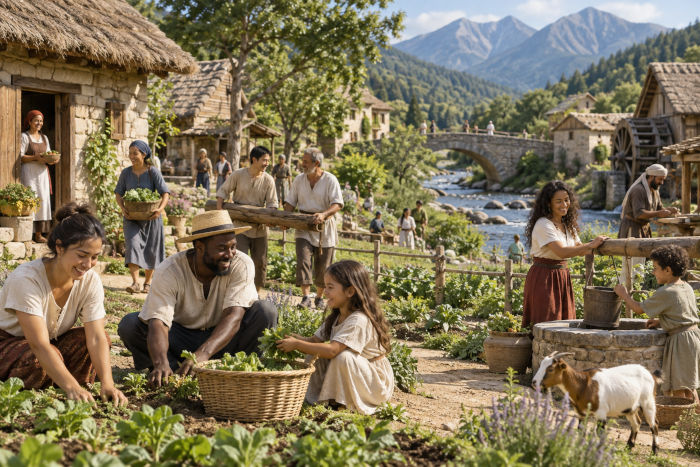
Children learned letters from medicine labels and fragments of packaging. They learned numbers by counting seeds. A surviving manual became the beginning of a school, not its final authority.
One spring morning, Imani walked with her pupils to the marsh. Frogs had returned. Above the reeds, an unfamiliar bird flashed blue.
“What is it called?” a girl asked.
Imani looked through the little book they had made together. There was no picture of it.
“I don’t know.”
The girl watched it settle on a branch.
“Can we find out?”
“Yes,” Imani said, handing her the pencil.
Behind them, the village was waking. Someone was lighting the bakery oven. Someone was arguing about a bridge. In the wet earth at the water’s edge, the children knelt to draw what they could see.